Blog December 8, 2022
Antivirus vs. EDR vs. XDR: Best Solution for your Cybersecurity
Compare traditional antivirus, endpoint detection and response, and extended detection and response for your cybersecurity strategy.
Most of us use an Antivirus to protect our devices, but technology now offers more reactive approaches to cybersecurity, named EDR and XDR. It is essential to protect our data and cyber security as individuals, but it is even more vital for companies to address the sophistication and prevalence of malware threats.
Basic Definitions
Before we go more into details, let's look at some definitions:
-
Antivirus
According to the US National Institute of Standards and Technology, antivirus software monitors systems for malware and helps prevent or contain infections. In other words, it is a program that aims to protect you and your devices from cyber threats. -
EDR= Endpoint Detection and Response
EDR combines endpoint monitoring with investigation and response to threats, as explained by Digital Guardian. -
XDR= Extended Detection and Response
VMware describes XDR as combining security data and tools to detect, investigate, and respond across multiple parts of an organization's infrastructure.
How do EDR and XDR differ from antivirus?
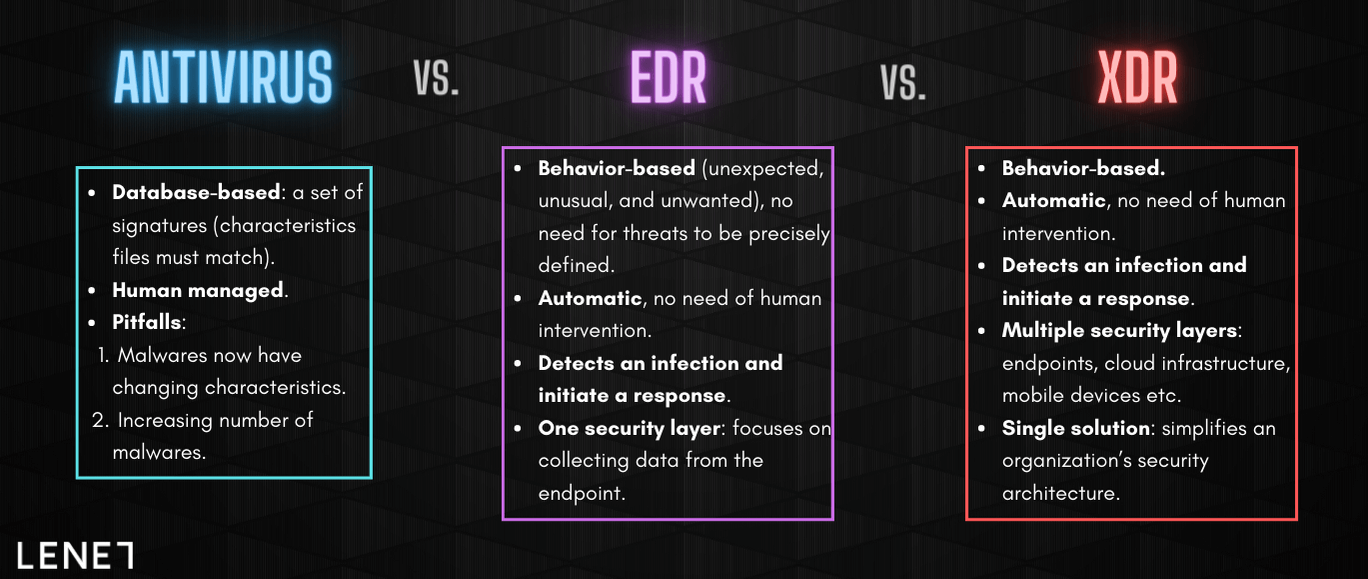
Original comparison from 2022. Detection and automated response depend on the product, configuration, and analyst oversight. Modern antivirus can also use behavioral detection.
Antivirus
Traditional signature-based antivirus relies on malware definitions and signatures maintained by security vendors. The traditional Antivirus database consists of a set of signatures, which may contain hashes of a malware file and/or rules with a set of characteristics the file must match. If a new malware's characteristics are not defined as a set of threat signatures by a human, then the antivirus won't be able to detect it.
Pitfalls of an Antivirus
It is getting increasingly difficult for IT professionals to keep up with the number of threats encountered. Why is it so? Mainly because the number of new malware samples seen daily is greater than the number any human team of signature writers can keep up with. Moreover, since signatures only focus on a few file characteristics, malware authors have learned how to create malware with changing characteristics, also known as polymorphic malware. This makes it even harder for signature writers to do an efficient job.
EDR vs. XDR
Their Similarities:
EDR and XDR recognize that not all modern attacks are file-based. Instead of focusing on signatures and detecting known, file-based threats, EDR and XDR focus on detecting unusual activity and providing a response. Since the threat doesn't need to be precisely defined in the way that it does for Antivirus solutions, EDR and XDR can look for unexpected, unusual, and unwanted activity patterns. When they do, they will alert a security analyst to investigate and address the threat.
One of the most significant benefits of an advanced EDR/XDR solution is that it can contextualize security data and automate supported responses, while analysts investigate and oversee the response.
Their Differences:
EDR stands for "Endpoint Detection and Response" and hence focuses on collecting data from the endpoint and examining that data for malicious or anomalous patterns in real time.
The endpoint is truly a significant target for cybercriminals and must be protected. However, each endpoint is only a component of an organization's IT infrastructure, while its network is actually composed of various systems. This is why attempting to manage a diverse network infrastructure with point solutions can be complex and overwhelming. In that sense, the fact that EDR focuses on the endpoint is also one of its pitfalls.
This is where XDR steps in. As XDR's name indicates (Extended Detection and Response), it integrates security visibility across an organization's entire infrastructure. Contrary to EDR, it doesn't focus only on endpoints but also on cloud infrastructure, mobile devices, and more. It is hence a great tool to simplify organizations' network security management. XDR is designed to provide integrated visibility and threat management within a single solution, dramatically simplifying an organization's security architecture.
XDR solution for an enhanced cybersecurity
An XDR solution can support several goals within a cybersecurity strategy:
- Multiple layers of security for your entire IT structure;
- Faster detection and response;
- A more in-depth view and understanding of threats.
When it comes to cybersecurity, decision-making can definitely be overwhelming. Contact LENET to discuss the right combination of prevention, detection, and response for your organization.